
By: James McCandless and Amber Serio – San Antonio Business Journal
Posted October 9, 2025
Story Highlights
• Family businesses face succession challenges as generations transition leadership roles.
• Next-generation leaders balance family legacy with new business approaches.
• Successful transitions require separating personal and business relationships.
Family businesses come in all shapes and sizes. Some are tiny restaurants that families have been cooking in for generations, others are publicly traded enterprises with global reach. But each of them, eventually, face the same issue. Who gets the keys when one generation retires?
Succession planning is nothing new, but every company approaches it diDerently. For some, it’s expected for someone in the family to want to join the business. For others, they’re left to find their own way, even if it’s back into the fold eventually.
The Business Journal reached out to several family businesses to find out how the next generation of business leaders is stepping into their roles, and how they want to carry their family’s legacy forward.
Living with the Lynds
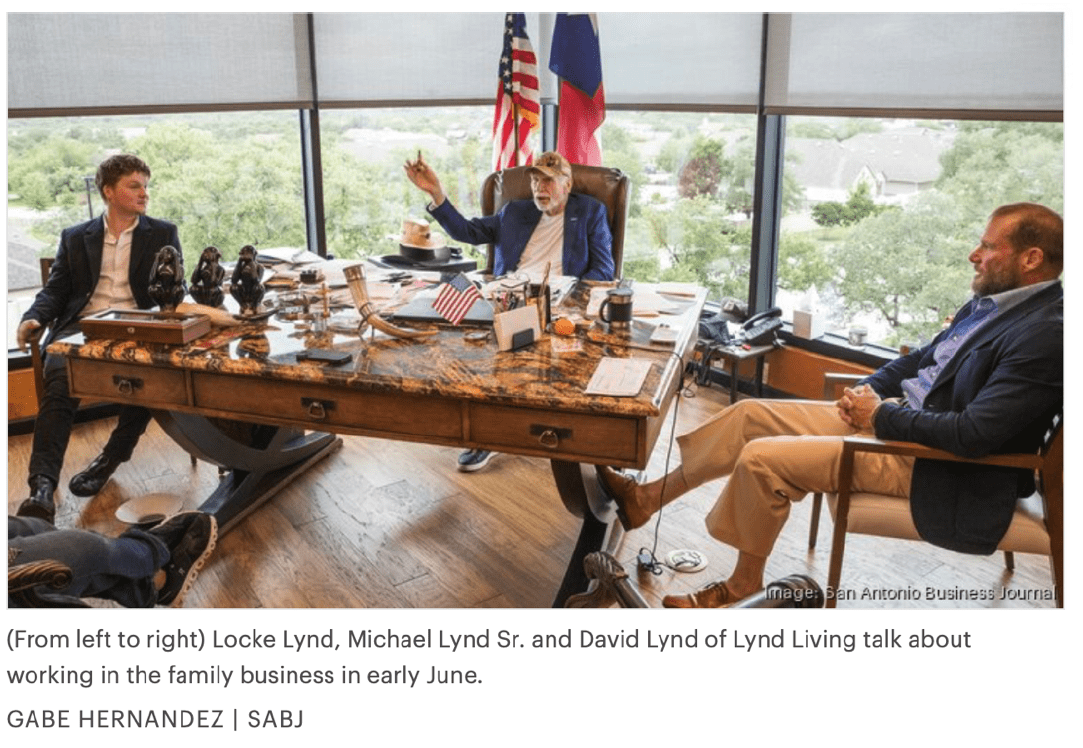
Anything can go wrong in a multifamily business, and with three generations between them, the Lynds have seen it all. In a joint interview this summer, David Lynd recounted how his father put him to work on properties across the city as a teenager, doing everything from maintenance to leasing.
He remembers digging up a broken sewer line one day, and managing a leasing oDice the next, as a fundamental lesson from his father, Michael Lynd. After the latter day, he handed David a check that was ten times larger than what he got dealing with a sewer line.
“He looked at me and said, ‘Look, son, I just wanted to explain to you one rule of life,’” Lynd recalled. “‘You can work your back to the bone on manual labor and make nothing, or you can go to college and get an education and make $100 a day. It’s your choice.’ Now, at the time, I just wanted to punch him in the face, because there’s a lot of easier ways to teach that, but that’s just the guy he was.”
Founded in 1980 by Michael, after serving in Vietnam and working at other real estate firms, it was never a given for him that family would join the company. But he wanted to set the expectation early that if you were going to jump in, you had to put everything into it.
“It’s tough,” Michael said. “You make them work harder. You make them come in at six o’clock, seven o’clock, when the rest of the workforce comes in at eight. You have to outwork them.”

David thinks that if you can’t separate your personal life from your family’s business life, then you shouldn’t bother jumping in. If you can’t go from having a high-level disagreement about a venture one minute to planning dinner the next minute, he says, it’s not worth doing.
“If you can’t do that, you cannot work with your family because one is personal and one is business,” David said. “Business is just business, you’re either doing your job or you’re not.
That’s a black and white issue. You have to be able to have a complete dustup and then divorce yourself from the emotions of that and go right back to the personal relationship. Most people just don’t have that.”
While not quite in charge yet, David’s son Locke has jumped in. He’s also done the grunt work, and he took a lead role in developing The Josephine, the company’s 261-unit apartment complex near Pearl, which it built in conjunction with Opportunity Home. That project came online earlier this year. The property leans heavily into tech and wellness, something Locke sees as the key to the future of the business.
It’s what the division he oversees, Lynd Labs, is focused on.
“The market gets tougher every single year, and with AI and robotics, that’s really what the solution is going to be like the internet was for (David)” Locke said. “It’s going to bring down operating costs significantly and allow those common-sense management practices to really rise to the top. If you build that into a platform, there’s going to be a couple big players, and they’re going to be able to swallow a large percentage of the market.”